
The False Sun Unblocked
- Horror
- Psychological
- Mystery
- Visual Novel
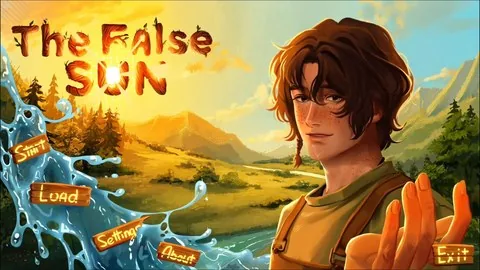
The False Sun starts with a place you recognise and a summer you cannot. You come back to your grandfather's farm after years away, and everything about the valley is right — the light, the fields, the buildings you could draw from memory — except that none of it comes with the memories that should belong to it. Then Silas says he was your best friend, and says it like a fact rather than a question, and the gap between what he remembers and what you can reach becomes the whole shape of the game.
This is a first-person horror visual novel, not a chase game. There is no combat, no health bar and no timer: progress is made by reading, responding and comparing. What makes it worth replaying is that it has twenty endings and no obvious correct route, so a friendly answer in one run can open a scene a cautious run never reaches. The Memory Gallery and Ending Gallery exist so you can hold several versions of the same summer side by side instead of guessing which one you were told.
About The False Sun
The farm is the point. A rural summer — chores, animals, weather, ordinary work — is exactly the kind of setting that reads as safe, and the game never lets the safety fully land. The valley is warm and green and completely indifferent to whether you can account for the last time you were there. Putting a comfortable place under a missing memory is what gives the story its pressure.
Silas is the reason the story cannot settle. He is warm, attentive, and entirely too certain about a friendship you cannot verify. Every conversation with him is a small calculation: how much to accept, how much to test, how far to step back. Nothing in the game forces you to distrust him, which is exactly what makes him difficult.
The mystery is memory rather than crime. There is no body and no perpetrator — only a gap where a summer should be, and people who fill it differently. Different routes surface different pieces of what happened, and some of them contradict each other. The endings are not a reward for solving it; they are what the story looks like from each position you can stand in.
How to Play The False Sun
Read the dialogue and choose how the protagonist responds. The game has no levels and no fail state — progress is measured in recovered memories, unlocked scenes and endings found. Change a few answers at a time on later routes so you can tell which decision opened what.
- Pick the protagonist gender before you start. It is a choice made once and carried through every scene, and picking it up front means you are not re-reading early conversations to find out what you committed to.
- Read before you answer. The dialogue carries the clues, and a reply chosen on reaction rather than comprehension is the most common way to end up on a thin route with nothing to compare it against.
- Do the farm tasks as they appear. Looking after animals and similar small activities are not filler between scenes — they change the pacing of a conversation and some routes only surface when you have spent time on the farm first.
- Change a small set of decisions on a replay, not all of them. Moving two or three answers at a time is what makes an ending traceable to a cause. Rewriting everything at once gives you twenty different first acts and no information about any of them.
Game Controls
| Control | Action |
|---|---|
| Mouse / Touch | Advance dialogue and select choices |
| Space / Enter | Advance dialogue |
| On-screen menu | Save, load, adjust preferences, and review the Memory and Ending Galleries |
How to Beat The False Sun
There is no single way to finish The False Sun. There are twenty endings, reached by changing how you respond across a summer, and the game is built to be played more than once rather than completed once.
Treat the First Ending as a Baseline
Answer naturally on your first route and see where it lands. You cannot plan twenty endings in one sitting, and a route chosen by reacting honestly gives you something concrete to compare the next one against. The galleries exist to make that comparison possible.
Isolate One Decision Per Replay
When you replay, change a small number of answers and note them. Large rewrites produce a different story with no visible cause, and you end up replaying for the moment rather than for the ending. Three changed answers is usually enough to see a branch open.
Push on Silas, but Test Him
The relationship responds to how you handle him — trusting, doubting, rejecting or keeping distance. The interesting routes come from testing what he says rather than accepting or dismissing it outright, because he gives you more the further you push, and the point where he stops being consistent is where the story turns.
Fill the Galleries, Then Chase What Is Left
The Memory Gallery records recovered fragments and the Ending Gallery records what you have reached. Once those are partially filled the game becomes much easier to navigate deliberately, because you can see which parts of the past you are still missing instead of guessing.
Important Items in The False Sun
There is no inventory in The False Sun. What you collect is information — memory fragments, scenes and answers — and the only item that matters is the one the game has not given you yet.
| Item | What it does |
|---|---|
| Memory fragments | Pieces of the missing summer. They return out of order, and comparing two that contradict each other is the main way the story reveals itself. |
| Unlocked scenes | Conversations and moments that only exist on certain routes. Missing one usually means a decision earlier put that option out of reach. |
| Ending Gallery entries | A record of which of the twenty you have reached, which is what makes a replay a comparison instead of a restart. |
The False Sun Difficulty Modes
The False Sun has no difficulty setting. What changes between playthroughs is how much of the story you are willing to give up, and how long you are prepared to sit with a route that refuses to resolve.
| Mode | Best for |
|---|---|
| First Summer | Getting the shape of the story before optimising anything |
| Comparative | Actually working out which decisions carry weight |
| Completionist | Players who want to see every version of the ending rather than one of them |
Tips and Strategies for The False Sun
Save Before Every Real Conversation
The game saves through its own menu rather than continuously, and a long dialogue is exactly where you will be tempted to reload or close. Save before it, not after you have already answered four questions you cannot take back.
Let Contradictions Sit
Two characters describing the same summer differently is the central device, not a mistake to reconcile immediately. Writing down which account came from whom makes the later revelations much easier to place.
The Farm Tasks Change Conversations
Time spent on chores is not dead time between scenes. Some of the strongest exchanges only become available once you have been around the farm long enough to ask about it, so skipping the tasks costs you content as well as pacing.
Do Not Assume One Safe Answer
There is no route that avoids the uncomfortable material — that is the subject, not a difficulty setting. If a particular kind of scene is where you would stop, the galleries and route notes let you pick up from a different point rather than abandoning the game halfway.
The False Sun FAQ
Is The False Sun an action game?
No. It is a first-person psychological horror visual novel: you read dialogue, examine scenes and choose responses. There are small interactive moments and mini-games between story sections, but no combat, no enemies and no fail state.
How many endings does The False Sun have?
Twenty. They are reached by how you respond across a summer rather than by a final decision, so a single playthrough only reveals part of the story. The Ending Gallery tracks which ones you have found.
What is the story about?
You return to your grandfather's farm and meet Silas, who claims to be a childhood friend you cannot remember. The game is about that gap — what happened in earlier summers, why the memories are unclear, and how much of what the village tells you can be taken at face value.
Do I need to replay the game?
To see the full story, yes. Progress is measured in recovered memories, unlocked scenes and endings, and the structure assumes you come back. Both galleries exist to make a second run a comparison rather than a restart.
Can I choose the protagonist?
Yes, you select the protagonist's gender before the story begins and it carries through every scene. Choose it on your first run so you are not replaying early dialogue to find out what you committed to.
Is there a combat or a jump-scare chase?
No. The tension is psychological and comes from the story, the relationship and the uncertainty about what you remember. There is nothing to fight and nothing to physically run from, and the horror is in the conversations.
What are the Memory Gallery and Ending Gallery for?
They are reference screens. The Memory Gallery holds recovered fragments of the past and the Ending Gallery records the twenty outcomes. Together they turn a replay into a deliberate comparison instead of a guess at what you did differently.
Is The False Sun suitable for younger players?
It is built for mature players. The store description carries an 18+ content warning for psychological horror and pressured relationship material, and the game opens on that warning. Read it before starting if that material is not for you.
The False Sun Gameplay Video
A full gameplay video of The False Sun, so you can watch a complete run before you start your own. The player loads from YouTube only when you press play.
More Horror Games
- Granny 3 — horror, survival, escape, playable instantly in the browser.
- Five Nights at Freddy's — horror, survival, jumpscare, playable instantly in the browser.
- Five Nights at Freddy's: Sister Location — horror, survival, jumpscare, playable instantly in the browser.