

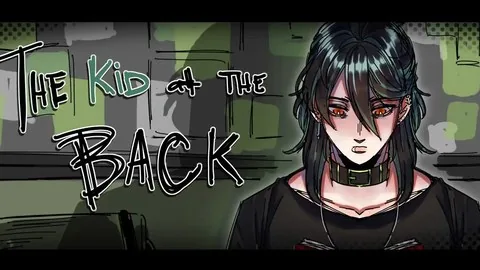

The Kid at the Back Unblocked
- Horror
- Psychological
- Yandere
- Visual Novel
You stay after class in a room that looks completely ordinary, and someone in the back row does not stop watching you. He is quiet about it. He does not need to say anything, because the game makes the watching itself the pressure. Then a second person arrives — charming, articulate, far easier to talk to — and the thing that was unnerving becomes a choice you have to keep making.
This is a first-person psychological horror visual novel, not a chase game and not a first-person stroller. There is no combat and no fail state while you are reading; what you do have is a school day that keeps putting you back in the same seat while the situation behind you changes. The tension comes from being observed, not from being pursued, and the routes diverge on who you answer instead of on what you uncover.
About The Kid at the Back
The kid at the back is introduced the way a real one would be: by where he sits and how little he says. Nothing about him announces itself. The game never confirms what he is, and the horror is that you keep checking anyway — the discomfort of a room where you cannot prove anything is wrong and cannot stop acting as if something is.
His rival exists to make him legible. Where one is silent and watchful, the other is articulate and generous, and having both pointed at the same person turns the story into a competition you did not agree to enter. Choosing a side feels like a decision; it is closer to a decision being made for you, one reply at a time.
The classroom is the point. Ordinary desks, ordinary light, an ordinary lesson that repeats — and a situation that is quietly impossible. Putting a familiar setting under that pressure is what makes this game work without ever showing violence for its own sake. The bad ending is reachable, and reaching it costs nothing except having answered carefully in the wrong direction.
How to Play The Kid at the Back
Read the dialogue and decide how the protagonist responds. There are no levels to fail and nothing to collect — progress is measured in which scenes open and which route you end up on. Change two or three answers at a time on later playthroughs so a branch can be traced back to a cause.
- Set the protagonist's name and pronouns before you start. They are fixed across the whole route, and choosing them up front means you are not re-reading early scenes later to find out what you committed to.
- Watch for screen shaking and visual distortion. Those are the game warning you that the next decision is load-bearing, and reading them as decoration is the most common way to walk into an ending you did not choose.
- Answer as the character you want to be, not the one you think will keep things calm. The routes respond to consistency, and a reply chosen purely to defuse tension is what closes off options later.
- Save before every significant decision. The game saves through its own menu, and the wrong answer often only becomes obvious several scenes afterwards when there is nothing to roll back to.
Game Controls
| Control | Action |
|---|---|
| Mouse / Touch | Advance dialogue and select choices |
| Space / Enter | Advance dialogue |
| Quick Save icon | Save to a slot without leaving the scene |
| On-screen menu | Save, load, switch between English and Simplified Chinese, and adjust preferences |
How to Beat The Kid at the Back
There is no single way to finish The Kid at the Back. You are choosing between two people who both want your attention, and the ending you reach is a record of what you chose and what you kept refusing.
Treat the First Route as a Baseline
Play it straight on your first run and see where it lands. A branching yandere route cannot be planned in one sitting, and a route chosen by reacting honestly gives you something concrete to compare the next one against. Note two or three answers you were unsure about while you go.
Learn the Warning Signs
Screen shake, distorted text and abrupt visual changes are the game telling you that the next decision matters more than the last one. Learn to pause when you see one. Treating them as atmosphere is how a good route turns into the bad ending without ever announcing that it happened.
Test One of Them, Then the Other
Push back on the quiet one but keep checking what he claims, or accept the charming one and read the fine print on his friendliness. The interesting content comes from testing a character rather than trusting or dismissing them outright, because both reveal more the further you go and both stop being consistent at some point.
Keep Multiple Saves
The routes split early and cross again later, so a single save slot will cost you the comparison that makes a replay informative. Two or three slots — one per route plus a shared one — is enough to see what a different answer actually changed.
Important Items in The Kid at the Back
There is no inventory in The Kid at the Back. What you collect is context — route-specific scenes, dialogue fragments and answers — and the item that matters is always the one somebody has just handed over without explaining why.
| Item | What it does |
|---|---|
| Route scenes | Conversations that only exist when you answered a particular question a particular way. Missing several usually means one earlier reply closed the branch. |
| Dialogue clues | Details that only pay off on a second run, when you already know what both characters are capable of and can hear the line that means it. |
| Quick Save slots | The only mechanic-adjacent item in the game. Two or three slots across separate routes is what makes a replay a comparison rather than a restart. |
The Kid at the Back Difficulty Modes
The Kid at the Back has no difficulty setting. What changes between playthroughs is how much of what it is showing you you are willing to sit with, and how long you keep answering in a voice that is not quite your own.
| Mode | Best for |
|---|---|
| First Day | Getting the shape of the story before optimising anything |
| Comparative | Working out which decisions are actually load-bearing |
| Completionist | Players who want to see what the other route was hiding |
Tips and Strategies for The Kid at the Back
Read the Warning Signs as Mechanics
Screen shake, text distortion and colour shifts are not decoration; they mark decisions that close routes. If you are unsure whether something is a warning or a style flourish, treat it as a warning and slow down. A wasted save costs less than the bad ending.
Do Not Answer to Keep Things Calm
It is very easy to shape your replies around what you think will defuse the situation, and the game gives you plenty of room to do it. The story is less interesting when you do, because a route built on appeasement is the one that turns. Answer as the character instead and see whether he can hold up under it.
Treat the Charming One as the Easier Read
He explains himself, which makes him feel safer and easier to trust — and he benefits most from you not looking closely. The route where you read him carefully reveals considerably more than the one where you take him at face value.
Note What You Chose Not to Ask
The questions you decline to ask shape the route as much as the answers you give. On a replay, deliberately ask the question you skipped first; it is usually the one that opens a scene you would never otherwise see, and it reframes several conversations you have already had.
The Kid at the Back FAQ
Is The Kid at the Back an action game?
No. It is a first-person psychological horror visual novel: you read dialogue, examine scenes and choose responses. There is no combat, no inventory to manage and no fail state while you are reading.
Who are the two characters competing for the protagonist?
One is the quiet student in the back row who watches constantly and barely speaks. The other is his rival — charming, talkative and much better at explaining himself. Your answers decide which route you are on.
Are there jump scares?
Not in the conventional sense. The developers describe the game as psychological horror without jump scares — the tension comes from atmosphere, character behaviour and the gap between attention and threat. There is nothing chasing you and nothing to run from.
What content warnings should I know about?
The game is rated 18+. The listed warnings include stalking, violence, kidnapping, abuse, psychological manipulation, blood and death. The in-game disclaimer also names non-consensual touching, sexual assault, implied abuse and weapons.
What does screen shake mean in this game?
It is a warning sign. Screen shake, distorted text and abrupt visual changes mark decisions that can close a route or push you toward the bad ending. Slow down when you see one instead of reading it as style.
How do I avoid the bad ending?
Watch for the warning signs before each significant choice, and pay attention to what each character offers you and how you answer. Save before every major decision so a wrong answer is a reload rather than a restart.
Can I change the protagonist?
You set the protagonist's name and pronouns before the story starts, and they carry through the whole route. Pronoun choices include he/him, she/her and they/them, and you can switch the game between English and Simplified Chinese from the menu.
Is The Kid at the Back suitable for younger players?
No. It is explicitly an 18+ title, and the game asks you to confirm you are over 18 and consent before it starts. There is no reduced-content version of the story.
The Kid at the Back Gameplay Video
A full gameplay video of The Kid at the Back, so you can watch a complete run before you start your own. The player loads from YouTube only when you press play.
More Horror Games
- Granny — horror, survival, escape, playable instantly in the browser.
- Five Nights at Freddy's 2 — horror, survival, jumpscare, playable instantly in the browser.
- Five Nights at Freddy's 3 — horror, survival, jumpscare, playable instantly in the browser.